




























Views
Downloads

Essential Animals and Their Babies Cut and Glue Worksheet

Paste this activity's link or code into your existing LMS (Google Classroom, Canvas, Teams, Schoology, Moodle, etc.).
Students can open and work on the activity right away, with no student login required.
You'll still be able to track student progress and results from your teacher account.
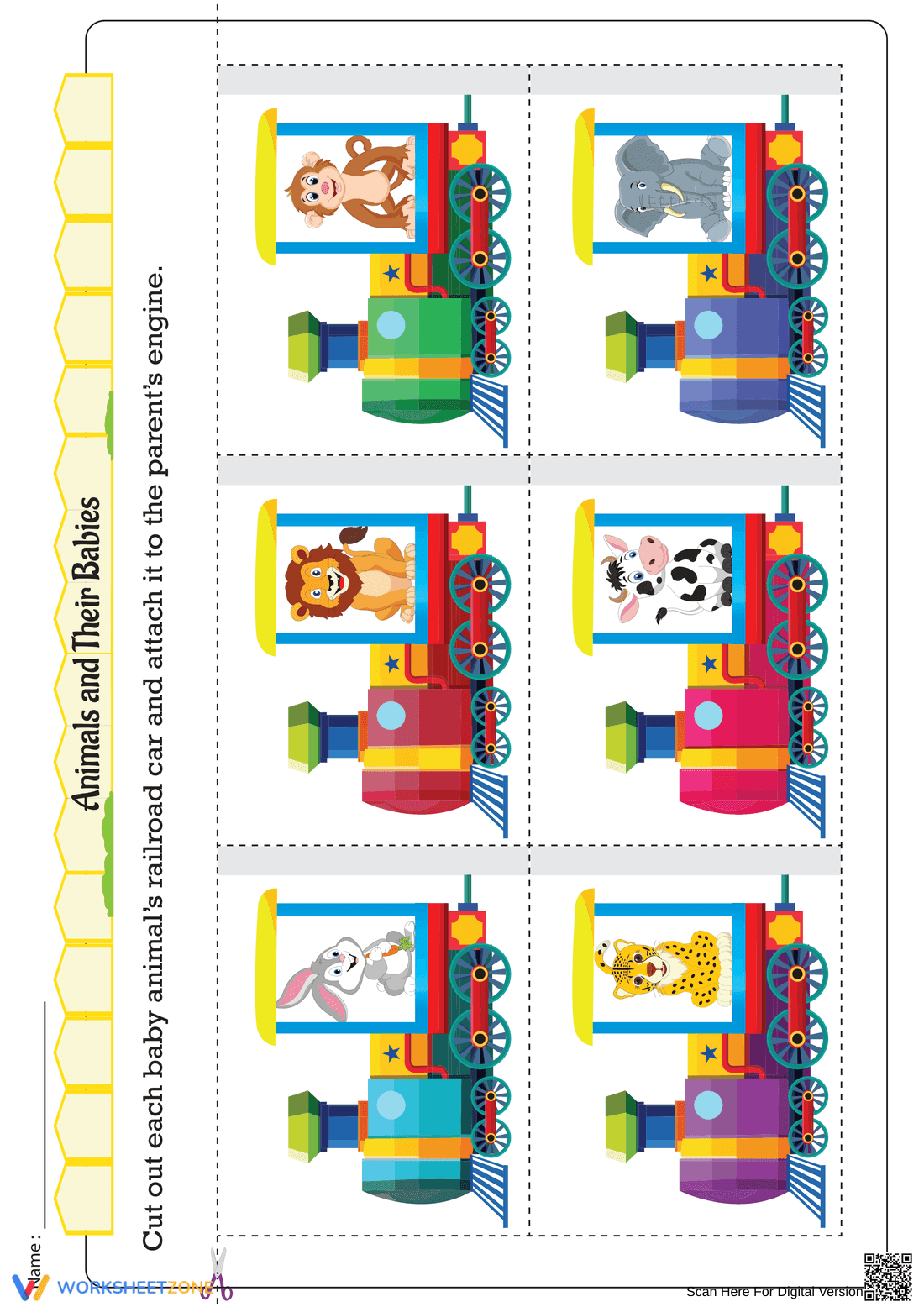
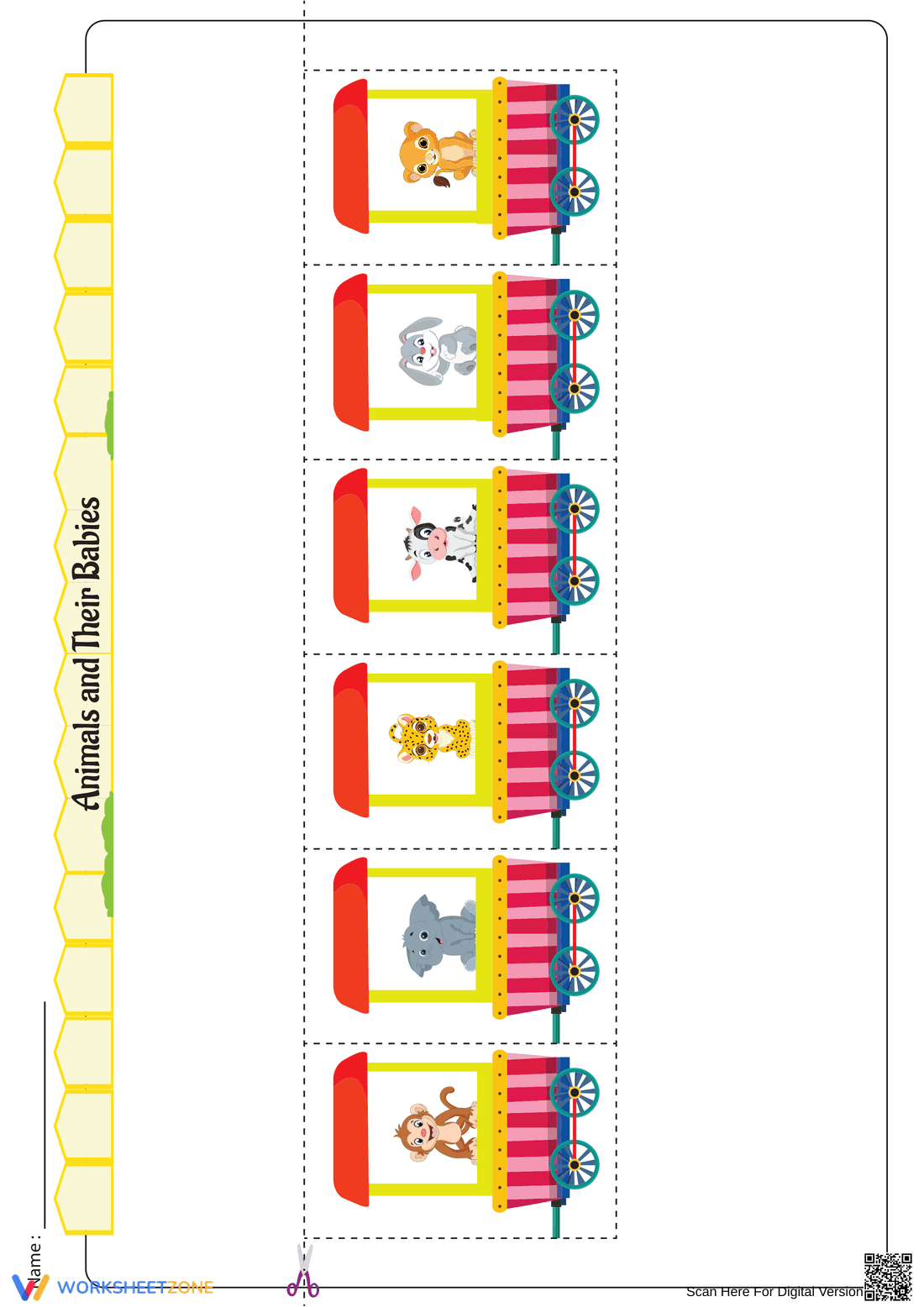
This interactive animals and their babies worksheet helps students identify the relationship between parent animals and their offspring through a fun train-themed matching activity. By cutting and gluing baby animal cars to the correct parent engines, learners develop essential observational skills and biological understanding.
At a Glance
At a Glance
- Grade: K–1 · Subject: Living Things
- Standard:
1-LS3-1— Make observations to account that young animals are like their parents- Skill Focus: Parent and Offspring Identification
- Format: 2 pages · 6 problems · Answer key included · PDF
- Best For: Science centers or independent practice
- Time: 15–20 minutes
What's Inside
This 2-page PDF features a structured layout for young learners. The first page contains six locomotive engines carrying different adult animals: a monkey, elephant, lion, cow, rabbit, and leopard. The second page provides the corresponding baby versions. The clear cutting lines and bold illustrations ensure that students can work with minimal assistance.
Zero-Prep Workflow
- Step 1: Print the two-page set for each student or pair (30 seconds).
- Step 2: Distribute scissors and glue, then have students cut out the six baby animal cars from the second sheet (5 minutes).
- Step 3: Review as students match each baby to its parent engine and glue them in place to complete the train (10 minutes).
Total teacher preparation time is under 2 minutes, making this an ideal resource for busy mornings or substitute sub plans.
Standards Alignment
The primary focus of this activity is `1-LS3-1`, which requires students to make observations to construct an evidence-based account that young animals are like, but not exactly like, their parents. This worksheet provides the visual evidence needed for students to identify physical similarities between species at different life stages. This standard code can be copied directly into lesson plans, IEP goals, or district curriculum mapping tools.
How to Use It
Use this worksheet as a summative activity after a lesson on animal families. A formative assessment tip is to observe students as they match the leopard and the lion; ask them to point out specific features like spots or manes that helped them decide. This identifies if they are using specific physical traits for classification. It typically takes 15 minutes to complete.
Who It's For
This resource is tailored for preschool, kindergarten, and first-grade students beginning to categorize the natural world. It is highly effective for English Language Learners due to the heavy reliance on visual cues. Pair this activity with a classroom picture book about animal families or a biological anchor chart for a comprehensive science unit.
Biological literacy in early childhood begins with the ability to recognize patterns in nature, specifically the inheritance of traits between generations. This `1-LS3-1` activity leverages the interactive cut and glue modality to reinforce the plain-English skill of identifying that baby animals resemble their parents. Research from Fisher & Frey (2014) emphasizes that tactile, hands-on tasks are crucial for reinforcing scientific vocabulary and conceptual mapping in the primary grades. By physically connecting the baby railroad car to the parent engine, students create a mental link that supports long-term retention of life science concepts. This method aligns with the NAEP framework for science, which values the application of observational data to explain natural phenomena. Teachers can confidently integrate this worksheet into a structured inquiry-based curriculum, ensuring that even the youngest learners meet rigorous state and national benchmarks for life science proficiency and observational accuracy.


